Private Coaching vs Team Practice: What Youth Athletes Need
Published June 3, 2026
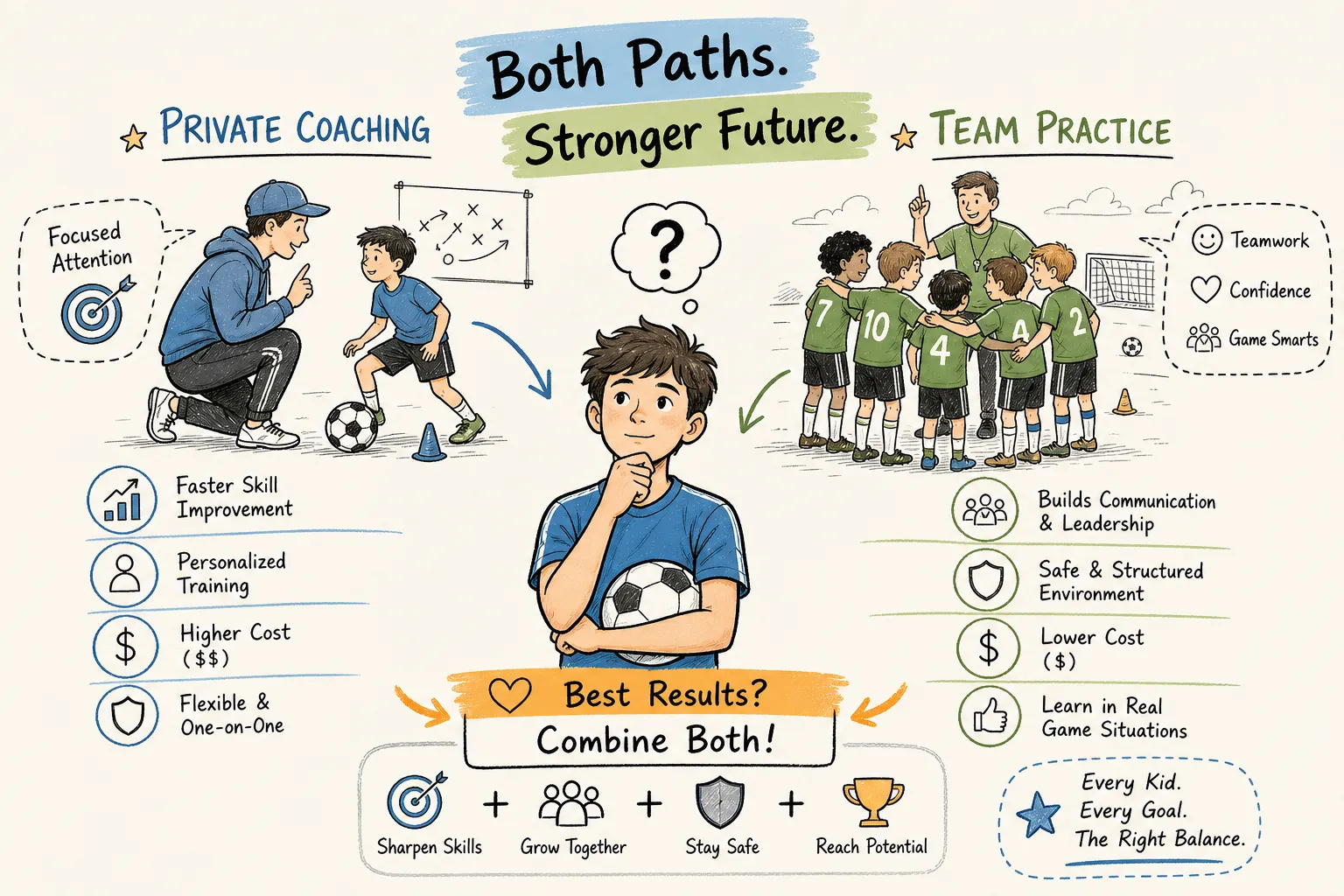 How does private coaching compare to team practice for youth sports? It's the question every sports parent eventually asks, usually while standing on the sideline after a tough game, doing mental math. Was that a team problem? A coaching problem? Or does your child just need some one-on-one time with someone who can fix that footwork? A lot of parents land on CoachSynQ mid-search and pause to ask the same honest question: "Is this actually going to help, or does my child just need more team reps?" That tension is completely reasonable. Private coaching and team practice are both real investments, and the stakes feel high when you're watching your kid struggle or plateau. The good news is that you don't have to choose one over the other. You just need to understand what each one does well, and what each one can't do at all. This article breaks that down clearly so you can build a plan that fits your child's actual development, not just someone else's Instagram highlight reel.
How private coaching compares to team practice: what individual sessions deliver
Private coaching is not magic. But when it's used well, it can accelerate certain targeted technical skills in ways that most group settings struggle to match. The reason comes down to attention. Team coaches often divide focus across a dozen or more athletes at once. A private session flips that ratio entirely.
Personalized feedback that group practice simply can't provide
In a private session, a coach can observe nearly every rep, correct mechanics immediately, adjust drills in real time, and build a progression designed for one athlete rather than the median of the group. That immediacy matters. Feedback that catches a developing bad habit early is typically more effective than trying to undo a pattern that's been repeating for months, a principle well supported in motor learning research. For skill areas like pitching mechanics, shooting form, footwork, or ball control, individual instruction can shorten the learning curve for specific technical skills in ways that are harder to achieve in a group setting.
Flexible scheduling around your child's real life
Private lessons can slot into almost any gap in the week, before school, Saturday morning, or a quiet stretch during the off-season. That flexibility removes the "we missed three weeks and now we're behind" problem that team-only development can create. It also means you can ramp up training before tryouts and ease off during exam season without disrupting a team schedule.
Focused work on the exact weaknesses holding your child back
Team practice runs a curriculum built for the group. Private coaching runs one built for a single athlete. If your child struggles with receiving under pressure or converting off the dribble, a 45-minute private session can often provide far more targeted repetitions on that specific gap than a typical team practice allows, depending on session structure and practice design. That concentration of purposeful reps on one weak point is where private coaching earns its price tag.
How private coaching compares to team practice: what group sessions build
Sports development experts are consistent on this point: team practice is not something to supplement away. It provides essential experiences that private sessions cannot fully replicate for broad athletic development. Private coaching versus team practice is not a competition, they build entirely different things.
Game-situation reps with real decision-making pressure
A skill performed in isolation and a skill performed in a live scrimmage are genuinely two different things. Team practice creates defensive pressure, teammate reads, chaotic transitions, and tactical execution that a one-on-one session cannot simulate. Coaches and sports scientists broadly agree that decisionmaking and game awareness develop through live group practice, not solo repetition. You simply cannot replicate that dynamic with one coach and one athlete.
Teamwork, communication, and the chemistry that wins games
The social skills built in group practice are not incidental, they are core athletic competencies. Trust, communication, shared accountability, and the sense of belonging that comes from being part of a unit all shape how an athlete performs when it counts. Youth athletes who skip team time in favor of private lessons may have difficulty applying isolated skill work to game contexts if they lack team practice experience. Technique alone doesn't win games.
Competitive intensity that private sessions can't manufacture
A good team practice creates pressure between peers. That pressure teaches athletes to perform when it's uncomfortable, which is exactly where private sessions have a structural limit. The group environment is where mental resilience gets built, and there's no substitute for learning to compete against someone who is also trying to win.
The real cost of private coaching and how often to add it
Before you start booking sessions, you need two practical numbers: what it costs and how much is safe. Both have clearer answers than most parents expect.
What private lessons for youth sports actually cost
Private coaching in the U.S. typically runs $40 to $120 per hour, with mainstream sports like soccer, basketball, baseball, and softball clustering between $50 and $80 per hour. Entry-level coaches generally charge $30 to $50 per hour, while experienced coaches with credentials tend to run $50 to $80. Elite coaches or former professionals often start above $90 and can exceed $100 per hour. These figures vary meaningfully by region and local market conditions. For national averages and a deeper breakdown of typical session rates, see the average cost of private sports coaching.
At one session per week, parents can expect to spend roughly $160 to $480 per month. Small-group sessions with two or three athletes can bring the per-athlete cost down to $30 to $60 per session, a smart option that makes private skill development more accessible without sacrificing much of the individual attention.
How many sessions per week is actually safe
This is where the risk of pushing too far too fast becomes very real. Adding private sessions on top of team practice increases total repetitive load, and repetitive load is the primary driver of overuse injuries in young athletes. A commonly recommended default is at most one private session per week for many youth athletes, kept to 30 to 60 minutes depending on age and intensity, with close monitoring of total load and recovery. Younger athletes in early developmental stages should treat private work as occasional and purpose-driven, not a standing weekly commitment. At least one full recovery day per week with no sport-specific work is non-negotiable, not a suggestion. Recent practice-based research on injury reduction and performance development in youth team sport settings supports a cautious approach to additional training load to minimize injury risk and promote long-term development (injury reduction and performance development research).
How to vet a private coach before your child steps on the field
Finding a qualified coach is only half the job. Knowing they're safe to work with your child is the other half. These are not the same thing, and the difference matters enormously.
Credentials and certifications that actually matter
Look for sport-specific coaching certifications, current first aid and CPR training, and documented training in child protection and abuse prevention. Credentials should be verifiable through the issuing organization, not just listed in a bio. A coach who can't clearly name their certifications or explain their screening process is a yellow flag worth following up on before you book anything. For practical steps on coach education and certification pathways, see guidance on how to become a youth sports coach.
Background checks and the practical signals of a safe coach
Any adult working privately with kids should clear a criminal background check and a sex offender registry check, that's the floor, not a bonus feature. Keep in mind that legal requirements for these checks vary by state and organization, so it's worth asking explicitly what screening has been completed and how recently. Identity verification should accompany any background screening. For an overview of standard practices and recommended checks, review resources on coach background checks.
Beyond paperwork, look for transparency: a quality coach will explain exactly what screening is done, how often it's updated, and what their child-protection policy covers. Red flags include any refusal to disclose screening details, no written safety policy, or "we just know them" offered as a substitute for formal vetting. Trustworthy coaches and programs treat safety documentation as a standard part of doing business, not an inconvenient request from an overprotective parent.
Building a simple plan that uses both without burning your child out
The best youth development plan isn't private coaching or team practice, it's both, used intentionally. Here's a framework that actually holds up.
The supplement-not-replace rule every parent needs
Private coaching is most effective when it amplifies what team practice is already building. Think of it this way: team practice develops the athlete as part of a unit; private coaching develops the individual within that unit. When parents treat private sessions as laser-focused tune-ups on one or two specific weaknesses, they get the best of both environments. When they use private sessions to log extra volume, they risk burnout and overuse without proportional skill gain. The goal is sharper execution in the team setting, not a second team practice in disguise.
Warning signs that the load has crossed a line
Watch for persistent fatigue, disrupted sleep, reduced enthusiasm before practices, irritability, or an athlete who starts treating every free hour as sport time. These are early signals of overtraining or burnout, and they're far easier to address at the first sign than after a full spiral. A reassessment every four to six weeks, covering mood, motivation, sleep quality, and performance trends, helps you catch problems before they become injuries or, worse, a child who decides they're done with the sport entirely.
Finding the right private coach without the endless searching
You now understand what you're actually looking for. The next step is finding it without spending two weeks digging through Facebook groups and outdated Google results.
Why a purpose-built marketplace beats a generic search
Finding a qualified private coach through a generic search means clicking through outdated websites, asking around in parent group chats, and hoping whoever shows up has been properly screened. CoachSynQ is built specifically for this challenge. It's a youth sports marketplace where parents can search by sport, player age, and location, read real coach profiles with availability and session details, message coaches directly before committing, and book and pay securely in one place. The platform covers a wide range of sports and includes virtual coaching options for skill-specific work that doesn't require being in the same zip code.
How to use filters to find the right fit, not just any coach
The practical advantage CoachSynQ offers is the ability to match a coach to your child's specific developmental stage, not just their sport. Filtering by age group and skill focus means a parent looking for a beginner soccer coach for a nine-year-old won't end up booking someone who specializes in high school strikers preparing for college recruitment. That specificity, across sport, age, location, and session type, is what makes a search productive instead of overwhelming.
The answer is "and," not "or"
When parents ask how private coaching compares to team practice for youth sports, the honest answer is that the question itself may be the wrong frame. The real question is how to use each one for what it does best. Team practice builds the whole athlete: the competitor who communicates, reads plays, and performs under pressure. Private coaching sharpens the individual skill gaps that hold that athlete back from contributing fully in the team setting. Put them together thoughtfully, keep the load in check, and vet any coach your child works with one-onone. That combination is where real, lasting development happens. If you're ready to find a private coach who fits your child's sport, age, and schedule, CoachSynQ makes that search simple, from browsing profiles to confirmed booking, all in one place.